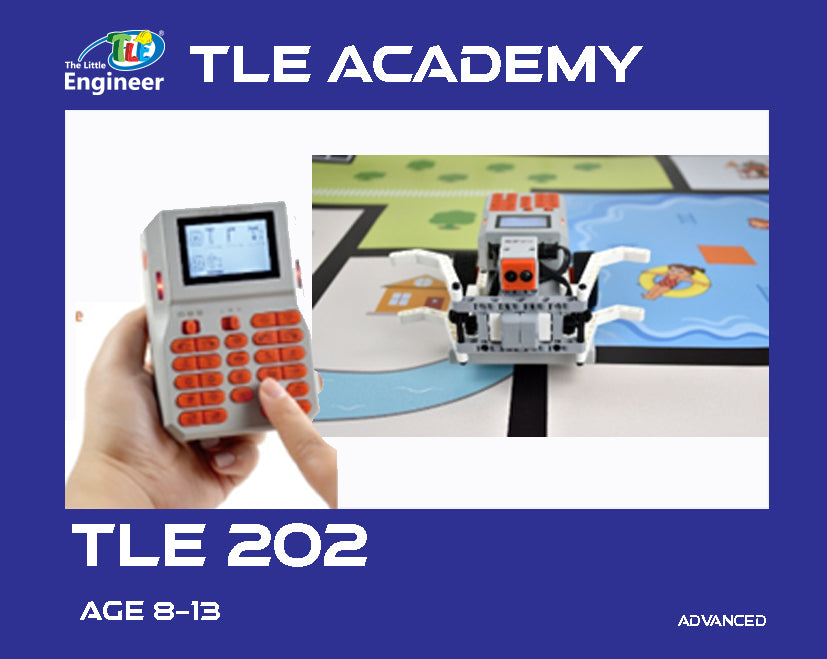
TLE 202
TLE 202
TLE 202® – Applied Robotics & Intelligent Machines
Build. Program. Sense. Create.
Robotics • Coding • Sensors • Engineering • Real-World Applications
TLE 202® is a hands-on robotics and engineering course by The Little Engineer® that takes learners from basic robotic construction into a much broader world of programmable vehicles, smart machines, humanoids, biomimetic robots, and engineering challenges.
Through a wide variety of models, learners discover how mechanical design, motors, sensors, controllers, and programming can work together to create machines that move, react, perform tasks, and imitate behaviors found in the real world.
From Models to Real-World Robotics
The learning journey progresses through:
Build → Program → Sense → Test → Troubleshoot → Improve → Challenge
Rather than learning robotics through one type of model, students experience how the same engineering and programming principles can be applied across transportation, industry, humanoid robotics, and biological behavior.
Five Learning Themes
Vehicles introduce learners to movement, navigation, and different transportation systems through the Mini Rover, Smart Driver, Light Tracker, Mars Rover, F1 Car, and Helicopter.
Industrial Machines connect robotics to practical applications through models such as the Forklift, Parking System, Highway Gate, Smart Trash Can, Mini Golf, Smart Golf Shot, Mousetrap, Maze Challenge, Musical Time Machine, Record It Yourself, Smart Elevator, and ATM Machine.
Humanoid Robotics introduces robots inspired by human movement and activities through the Attacker Robot, Sports Robot, Robotic Fitness, Robot Traffic Officer, and Violinist.
Animal & Human Behavior explores biomimetic and functional robotics through the Bionic Spider and Robotic Hand, helping learners see how engineers can draw inspiration from living systems.
Finally, Competition Challenges allow learners to apply their acquired skills through Path Planning and Park Challenge activities.
From Movement to Intelligent Behavior
TLE 202® helps learners understand that a robot is more than a moving construction.
Through programming and sensor-based activities, they begin to explore the relationship:
Input → Program → Decision → Action
A robot can receive information, process programmed instructions, and respond with an appropriate movement or behavior.
This is an important transition from building a machine to understanding how to make the machine behave intelligently.
What Will Learners Develop?
Learners strengthen skills in robotics, coding, sensor integration, mechanical construction, movement control, computational thinking, logical reasoning, debugging, troubleshooting, creativity, problem-solving, and engineering design.
The diversity of models also exposes learners to different areas of technology—from transportation and industrial automation to humanoid and biomimetic robotics.
Learning Through Challenges
The final challenge-based activities encourage learners to move beyond following instructions and apply their accumulated knowledge to planning, programming, testing, and improving their own robotic solution.
Build the Machine. Program the Behavior. Solve the Challenge.
TLE 202® — Exploring how robotics can move, sense, behave, and solve real-world problems.
Course Areas: Vehicles • Industrial Machines • Humanoids • Animal & Human Behavior • Competition
Focus: Robotics • Coding • Sensors • Engineering • Intelligent Behavior
Final Challenges: Path Planning • Park Challenge
Learning Style: Hands-On • Project-Based • Application-Based • Challenge-Based
Couldn't load pickup availability