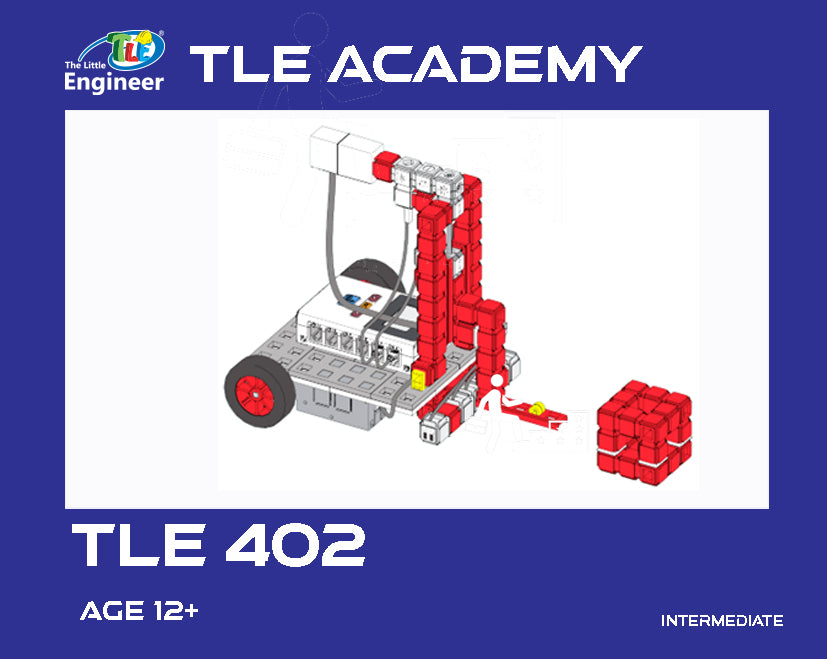
TLE 402
TLE 402
# TLE 402® – Robotics & Autonomous Systems
### Build. Sense. Navigate. Solve.
**Ages 12+ | Foundation Model + 8 Robotics Projects | Autonomous Systems • Sensors • Engineering Challenges**
**TLE 402®** is an advanced hands-on robotics and autonomous systems course by **The Little Engineer®**, designed for learners aged **12 and above** who are ready to move from guided robotics into **mission-based engineering and problem-solving**.
The course begins with a **Basic Wheeler foundation model**, giving learners an understanding of robotic structure, movement, and control. They then progress through **8 increasingly challenging robotics projects**, where they design, build, program, test, and improve robots to accomplish specific missions.
From navigating a maze and avoiding obstacles to detecting sound, following a line, responding to simulated emergency scenarios, and handling objects, TLE 402® challenges learners to think beyond simply making a robot move.
They learn to ask:
**What does the robot need to sense? What decision should it make? And how should it act to successfully complete the mission?**
## From a Basic Robot to an Autonomous System
TLE 402® begins with the **Basic Wheeler**, a mobile robotic platform that forms the foundation for the projects ahead.
As learners progress, they modify and expand their robot to give it new capabilities. Different sensors, mechanisms, programming logic, and engineering solutions are introduced depending on the challenge.
Students explore:
* Robotic structures and movement
* Autonomous navigation
* Programming logic and decision-making
* Sensor-based control
* Obstacle detection
* Sound detection and response
* Line tracing
* Force, balance, and interaction
* Timing and task sequencing
* Robotic mechanisms
* Object manipulation
* Testing and optimization
* Troubleshooting and debugging
The learning journey follows the engineering cycle:
**Understand → Design → Build → Program → Test → Analyze → Improve → Solve**
## Foundation Model – Basic Wheeler
Learners begin by building and exploring the **Basic Wheeler**, developing an understanding of the structure, movement, and control of a wheeled robotic system.
This foundation provides the platform that students will progressively transform into different autonomous robotic solutions throughout the course.
## The 8-Project Robotics Journey
### Project 1 – Maze Runner Robot
Learners design and program a robot capable of **navigating through a maze**, developing their understanding of movement, route planning, logic, and decision-making.
### Project 2 – Jousting Challenge Robot
Students develop a robotic solution that applies **force, balance, interaction, and strategy** in a competitive engineering challenge.
### Project 3 – Relay Race Robot
Learners program their robot to perform tasks in sequence, exploring **timing, coordination, collaboration, and systematic problem-solving**.
### Project 4 – Object Avoidance Robot
Students use sensor input to create a robot capable of **detecting obstacles and changing its behavior to avoid them**.
This introduces an important principle of autonomous robotics: using information from the environment to make programmed decisions.
### Project 5 – Sound Detecting Robot
Learners explore how robots can **detect and respond to sound stimuli** using sensors and programming.
They investigate the relationship between input, programmed logic, and robotic response.
### Project 6 – Fire Fighting Robot
Students design a robotic system that can **detect and respond to a simulated fire-related scenario**, applying robotics and engineering to a real-world problem.
The project encourages learners to think about how autonomous technologies can support **safety, sustainability, and human needs**.
### Project 7 – Line Tracing Robot
Learners develop a robot capable of **following a defined path using sensors and control logic**.
They experiment with sensor readings, movement, positioning, and programming adjustments to improve the robot's accuracy and performance.
### Project 8 – Object Handling Robot
The learning journey culminates with learners creating a robotic system capable of **picking up, moving, and placing objects**.
This project brings together mechanical design, programming, movement, control, and problem-solving in one integrated robotic challenge.
## Learn Through Challenges, Not Just Instructions
TLE 402® takes a different approach to robotics learning.
Rather than simply asking students to reproduce models, each project presents a **problem or mission to solve**.
Learners must determine how their robot should be constructed, how it should move, what information it needs from its sensors, and how its program should respond.
When a solution does not work as expected, students are encouraged to **analyze, troubleshoot, modify, and test again**.
This iterative process is at the heart of both engineering and innovation.
## From Sensing to Autonomous Action
A central concept of TLE 402® is helping learners understand how an autonomous system interacts with its environment:
**Sense → Process → Decide → Act**
A robot may detect an obstacle, recognize a line, respond to sound, navigate a route, or manipulate an object—but successful autonomous behavior depends on combining **hardware, sensors, programming logic, and mechanical design**.
Learners gradually discover how these elements work together to create smarter robotic systems.
## What Will Learners Develop?
Through the TLE 402® learning journey, students strengthen:
* Autonomous robotics skills
* Programming and algorithmic thinking
* Sensor integration
* Navigation and route planning
* Mechanical and robotic design
* Logic and decision-making
* Computational thinking
* Engineering problem-solving
* Testing and optimization
* Debugging and troubleshooting
* Critical and analytical thinking
* Creativity and innovation
* Communication and collaboration
* Confidence in developing their own solutions
## Connected to MYP Learning
TLE 402® activities support an inquiry- and project-based approach aligned with key elements of the **MYP learning framework**.
Projects encourage learners to explore concepts including **Systems, Function, Interaction, Development, Logic, Balance, Innovation, and Responsibility**, while strengthening ATL skills such as **Thinking, Research, Communication, Collaboration, Social, and Self-Management skills**.
This makes the course particularly relevant for learners who are developing the ability to connect **STEM knowledge with real-world challenges and interdisciplinary thinking**.
## Build the Robot. Program the Mission. Engineer the Solution.
TLE 402® takes learners beyond building and programming individual models into the world of **autonomous robotics and engineering challenges**.
Across a foundation model and **8 progressive projects**, students learn how to transform a basic robotic platform into systems capable of navigating, sensing, responding, competing, following paths, and manipulating objects.
The goal is not simply to create a robot that works.
It is to develop a learner who can **understand a problem, design a solution, test an idea, learn from failure, and improve it until the mission is accomplished.**
**TLE 402® — Build the robot. Program the mission. Solve the challenge.**
*Part of the TLE Academy learning pathway by The Little Engineer®.*
**Recommended Age:** 12+
**Course Structure:** Foundation Model + 8 Projects
**Foundation Model:** Basic Wheeler
**Focus:** Autonomous Robotics • Sensors • Navigation • Smart Systems • Engineering • Problem-Solving
**Learning Style:** Hands-On • Mission-Based • Project-Based • Challenge-Based
**Educational Framework:** MYP-Aligned Concepts & ATL Skills
Couldn't load pickup availability