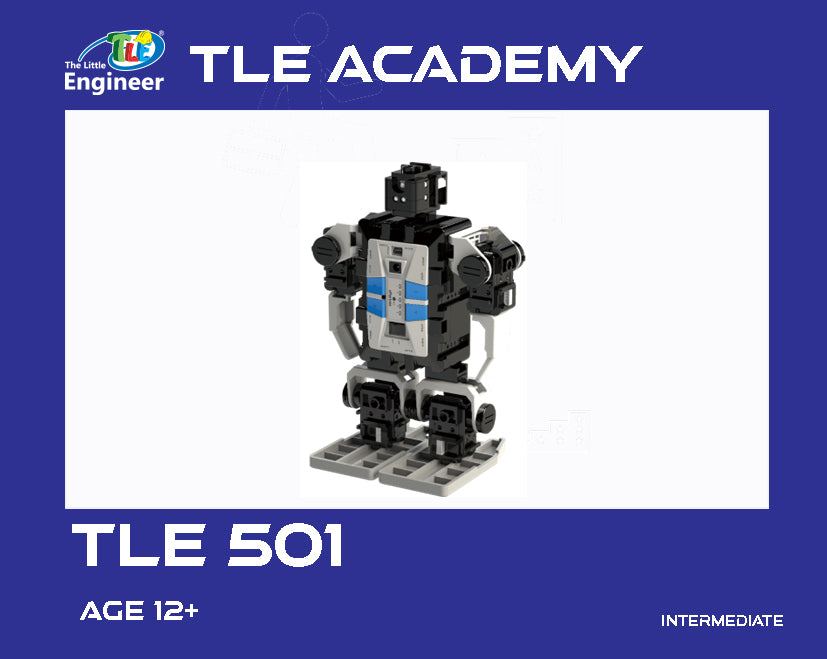
TLE 501
TLE 501
# TLE 501® – Intelligent Robotics & Sensor-Based Systems
### Sense. Think. Respond. Innovate.
**Ages 12+ | 10 Advanced Models | Intelligent Robotics • Sensors • Motion Control • Programming**
**TLE 501®** is an advanced hands-on robotics and programming course by **The Little Engineer®**, designed for learners aged **12 and above** who are ready to explore how robots can use sensors, programming, and advanced movement to interact intelligently with their surroundings.
Across **10 progressive models**, learners move beyond basic autonomous movement and begin creating robotic systems that can **detect sound, measure distance, respond to objects, control different directions of movement, and perform multiple programmed actions**.
Students explore how sensors provide information to a robot and how programming transforms that information into an appropriate response.
The result is a deeper introduction to the logic behind **intelligent and responsive robotic systems**.
## From Autonomous Robots to Responsive Systems
TLE 501® challenges learners to think beyond:
**“How do I make my robot move?”**
and begin asking:
**“What does my robot detect, how should it interpret that information, and what should it do next?”**
Throughout the course, learners explore:
* Advanced robotic construction
* Sensor-based programming
* Sound sensing
* Distance measurement
* Object detection
* Motion and directional control
* Multiple Degrees of Freedom (DOF)
* Angle and rotation control
* Switch-based control
* Subprograms and program organization
* Autonomous responses
* Mechanical design
* Troubleshooting and optimization
The learning process follows an advanced engineering cycle:
**Build → Program → Sense → Respond → Test → Analyze → Improve**
# The 10-Model Learning Journey
### Model 1 – Windmill
Learners explore the fundamentals of **transforming motion from one direction to another** while using switch buttons to control the system.
### Model 2 – Sound Intensity Measuring Device
Students are introduced to **sound sensing** and explore how sound input can be used within a programmed system to control rotational movement.
### Model 3 – Car Park Barrier
Learners investigate rotational movement and begin exploring **different Degrees of Freedom (DOF)** through an automated real-world application.
### Model 4 – PTZ
Students build a system capable of movement across **two Degrees of Freedom**, using switch controls to explore multidirectional positioning and movement.
### Model 5 – Earthworm
Learners create a robotic model that can **detect an object and change its direction of movement**, introducing more advanced sensor-based behavior.
### Model 6 – Aggressive Duck
Students explore how a robot can respond when an object approaches its sensor, programming different movements and reactions based on its surroundings.
### Model 7 – Cannon
Learners combine **sound input and switch controls** to trigger and control mechanical actions, exploring how multiple inputs can influence a robotic system.
### Model 8 – Tricycle with Horns
Students take an important step forward in programming by learning how to use **subprograms**.
They break complex robotic behaviors into smaller programmed actions and combine these within a main program. Sensor input is also used to help the robot detect and avoid obstacles.
### Model 9 – Penguin
Learners combine **sound and distance sensing** to control different actions of the robotic penguin, discovering how multiple sensor inputs can create more sophisticated behaviors.
### Model 10 – Biped Monster
The course culminates with a more advanced robotic creation where learners control movement across **two Degrees of Freedom** while using distance sensing to influence the robot's behavior.
# Sensors Make Robots Smarter
A central focus of TLE 501® is understanding how robots interact with their environment.
Learners discover that a robot can receive information through sensors and use its program to determine what happens next:
**Sense → Process → Decide → Respond**
For example, a robot may detect an approaching object, measure its distance, hear a sound, or receive input from a switch. The learner then determines through programming **how the robot should respond to that information**.
This introduces students to important concepts behind intelligent machines and autonomous systems.
# From Simple Programs to Subprograms
TLE 501® also develops learners' programming skills by introducing **subprograms**.
Instead of creating one long sequence of instructions, students learn how to divide complex robotic behaviors into smaller, organized functions or actions and integrate them into a main program.
This develops stronger:
* Programming logic
* Computational thinking
* Program organization
* Problem decomposition
* Debugging skills
* Algorithmic thinking
These concepts provide an important foundation for more advanced programming and intelligent systems.
# Understanding Degrees of Freedom
Learners are also introduced to the concept of **Degrees of Freedom (DOF)**—how robotic mechanisms can move and rotate in different directions.
Through models such as the **Car Park Barrier, PTZ, and Biped Monster**, students explore how mechanical construction and programming work together to create controlled multidirectional movement.
This helps build a stronger understanding of the principles used in **robotic arms, mobile robots, camera systems, industrial robotics, and other automated machines**.
# What Will Learners Develop?
Throughout TLE 501®, students strengthen:
* Advanced robotics skills
* Sensor-based programming
* Sound and distance sensing
* Motion and directional control
* Understanding of Degrees of Freedom
* Subprograms and structured programming
* Algorithmic and computational thinking
* Mechanical design
* Autonomous decision-making
* Debugging and troubleshooting
* Critical and analytical thinking
* Engineering problem-solving
* Creativity and innovation
* Confidence in designing responsive robotic systems
# Build Intelligence Into the Robot
TLE 501® takes learners beyond robots that simply execute predefined movements.
Students begin creating systems that **sense what is happening around them and use programmed logic to determine how they should respond**.
Across 10 increasingly sophisticated models—from a Windmill and Sound Measuring Device to an obstacle-avoiding Tricycle, responsive Penguin, and Biped Monster—learners discover how **mechanics, sensors, programming, and intelligent behavior come together in modern robotics**.
**TLE 501® — Sense the environment. Program the response. Build intelligent behavior.**
*Part of the TLE Academy learning pathway by The Little Engineer®.*
**Recommended Age:** 12+
**Course Structure:** 10 Advanced Models
**Focus:** Intelligent Robotics • Sensors • Programming • Motion Control • Autonomous Behavior
**Key Concepts:** Sound Sensing • Distance Sensing • Degrees of Freedom • Subprograms • Responsive Systems
**Learning Style:** Hands-On • Project-Based • Experiment-Based • Challenge-Based
Couldn't load pickup availability